For some reason, I receive each month a couple of requests from bloggers to make guest posts on my blog. I'm happy to consider such posts, and have done one or two in the past, but they must follow the three As: ACCURATE, ASTUTE, and ANALYTICAL. In other words, no pop history and no lists like "X Reasons You Should Do Y" or whatever. There are plenty of other blogs that do that sort of thing.
I also get emails from people who want me to post or link to their "infographics." They tend to be quite sharp looking pics but some fail all three A criteria specified above and I have yet to see one that was sufficiently analytical. Again, there are plenty of blogs out there that post infographics.
And please do NOT send me emails claiming that you have read my blog with interest, etc. and then display the utmost ignorance about its actual content.
But rest assured I'll happily trade with anyone who offers a mutually beneficial proposal.
Friday, October 19, 2012


Tuesday, September 25, 2012
When Will America Have Its "Charlie Moment"
Last night on Revolution, a new show on NBC that depicts the remnants of the USA 15 years after electricity suddenly stopped working, Charlie (the hot blondie blue chick) chastised two compatriots because they were so intent on stealing a sniper rifle that they had not even thought about what the sniper was guarding ... thirty enslaved people. The show is fictional, of course, but hardly irrelevant: people today, in the good ole USA, are working against their will, usually at mere subsistence levels. When will some Charlie out there awaken the nation to the slaves amongst us? Well, President Obama may be trying to do so, TODAY, 25 Sept. 2012, in his speech from the Clinton Global Initiative at Noon EDT. We shall see.
Monday, September 10, 2012
Yvette Clarke not entirely wrong
Yes, I saw Stephen Colbert's interview of Yvette Clarke (D-NY) in which Ms. Clarke professed to believe that slavery existed in New York City in 1898. That is eighteen ninety eight, 30+ years after the Civil War, the Emancipation Proclamation, and the 13th amendment of the U.S. Constitution ended formal slavery. Clearly, Clarke was confused about the chronology, even claiming that the Dutch were the culprits.
Yet, Clarke was not entirely wrong because various forms of unfree labor continued in NYC and elsewhere in 1898. In fact, they persist to this day, even in America. So Clarke would have been right to tell the New Yorkers of 1898 to set the enslaved free. The ironic thing is that she should be saying that today, too: set free everyone, white or black, male or female, American or otherwise, who have no or limited choices due to the power of their pimp, handler, or warden. I've laid how out in Fubarnomics and will continue to do so as editor of a new book series, about which more anon, tentatively titled Slaveries Since Emancipation.
Yet, Clarke was not entirely wrong because various forms of unfree labor continued in NYC and elsewhere in 1898. In fact, they persist to this day, even in America. So Clarke would have been right to tell the New Yorkers of 1898 to set the enslaved free. The ironic thing is that she should be saying that today, too: set free everyone, white or black, male or female, American or otherwise, who have no or limited choices due to the power of their pimp, handler, or warden. I've laid how out in Fubarnomics and will continue to do so as editor of a new book series, about which more anon, tentatively titled Slaveries Since Emancipation.


Thursday, August 23, 2012
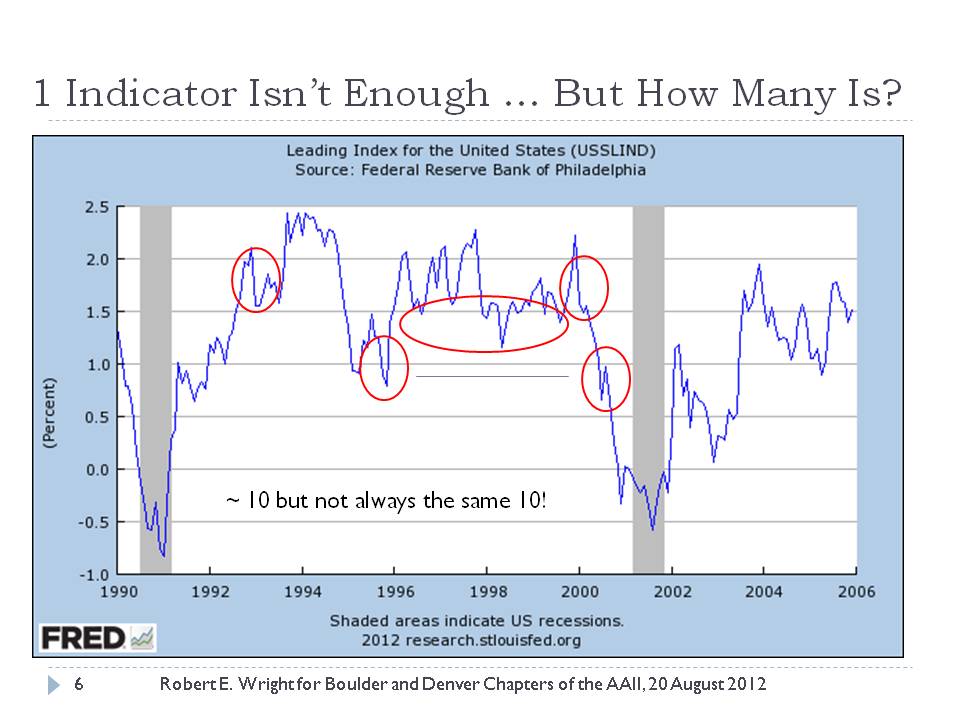
100s of Indicators But These 10 You MUST Watch
These are the PowerPoint slides I used during recent presentations to the AAII (American Association of Individual Investors) in Boulder and Denver, Colorado in support of my book with Simon Constable called The Wall Street Journal Guide to the 50 Economic Indicators That Really Matter.




Thursday, August 16, 2012
Healthcare and Insurance Reform: Innovation Zones, Vertically Integrated Mutuals, and Hybrid Policies
McKinsey & Co. was supposed to publish this in some forthcoming piece about mutuals and co-ops but just called to say that it isn't going to publish anything so controversial during a presidential race. So I append below my original draft. There is some chance that the edited version will eventually appear, presumably after the election, and quite a lot of their editing went into it, so I won't post the that version, just my original IP. I realize I haven't blogged in awhile but I'll have some investment-related stuff very soon.
The
U.S. healthcare system is ill. Prices for medical services (and hence insurance
premiums) have increased faster than inflation for decades and now comprise
almost one fifth of aggregate economic output. No end to the trend appears in
sight. Some American hospitals and doctors offer the best medical treatment in
the world, bar none, but most Americans can afford access only to lower tier
services that palpably lag global best practices. Tens of millions have no
insurance whatsoever and suffer for it financially, psychologically, and biologically
when they are sick or injured.
In 2010, the U.S. federal government
responded to those signs of illness by passing the Patient Protection and
Affordable Care Act (PPACA). The mammoth law, much of which phases in
incrementally with complete implementation coming in 2020, tries to address
perceived problems by direct fiat. Millions of Americans are uninsured, so the
law proclaims that they will be fined up to 2.5 percent of income (by 2016) if
they do not acquire insurance (the so-called individual mandate). Pre-existing
conditions raise insurance premiums or preclude coverage altogether so insurers
will be forbidden to use them in underwriting decisions by 2014. Copayments
reduce the number of scheduled appointments so they are to be banned for
preventive care and checkups in 2018. And so forth.
The U.S. Supreme Court (SCOTUS) may
declare the individual mandate unconstitutional and could possibly strike down
the entire law. Regardless of the court’s decision, which will likely come down
to a single vote, America must face the reality that PPACA treats the
healthcare system’s symptoms without doing much to cure its underlying disease,
asymmetric information. Healthcare and its insurance is rife with adverse
selection, moral hazard, and agency costs and until those problems are reduced
the system will continue to perform in a suboptimal, if not dysfunctional,
manner.
In the context of healthcare,
adverse selection is the greater propensity of people who are sick, or who are
likely to become sick, to seek insurance. Insurers reduce it by increasing the
premiums of people known to be sick or who have a history of illness and by declining
to cover pre-existing ailments. They also mostly insure employed individuals,
who unsurprisingly are on average healthier than people out of the labor force (other
relevant factors like age and gender held constant).
Moral hazard manifests itself in
healthcare by the greater propensity of insured people to seek medical
treatment for any given medical complaint. Insurers traditionally reduce it
with copayments and deductibles. A copayment of $5 or $10 keeps insureds with
the lowest incomes and most trivial ailments from utilizing scarce medical
resources. Deductibles, healthcare expenses that insureds must pay out of
pocket before insurance becomes effective, have a similar effect, at least
until they are met.
Agency problems occur when healthcare
providers (HCPs) exploit the presence of insurance coverage to over-diagnose and
over-treat patients. Doctors feel justified in breaking their Hippocratic Oath
(the most widely used modern version of which enjoins doctors to avoid the
“twin traps of overtreatment and therapeutic nihilism”) by pointing to the high
costs of malpractice lawsuits: better to order yet another test lest the HCP be
sued later on. To protect themselves from those agency costs, insurers limit
what they will pay for specific procedures and refuse to pay for treatments that
they believe are unwarranted. Unfortunately, most healthcare insurers today
have incentives to behave in a short-sighted and niggardly fashion toward
insureds, most of whom cannot change insurers, and whose deaths would benefit
insurers’ shareholders.
PPACA does not develop better ways
of mitigating the costs associated with any of those three types of asymmetric
information and in some instances, like abolishing the use of pre-existing
conditions, even exacerbates them. (Some critics argue that its main purpose is
to drive insurers out of business, thereby opening the door to a
government-based healthcare system.) That PPACA does not address key economic
issues is unsurprising given that it was clearly a political solution to what
many took to be a largely, if not purely, political problem. A more economic,
less hubristic approach would be to allow market participants to experiment to
find ways of mitigating the problems of asymmetric information that plague the
healthcare system. That might entail nationwide deregulation of healthcare and
health insurance markets or, more conservatively, the establishment of one or
more healthcare innovation zones (HCIZs) where such experimentation could
lawfully take place. (Judging by reactions to PPACA in some parts of the nation,
there would be no shortage of volunteer states or regions.)
When free to look after their own
interests, sellers and buyers of simple goods and services are so efficient at
determining equilibrium price, quality, and quantity that only the most
despotic governments intervene in the process, almost invariably with
disastrous results. With more complex services, however, especially those
involving a high degree of asymmetric information, governments become more
heavily involved. The efficacy of government involvement varies depending on
its exact nature but is often sufficiently uncertain to prevent a consensus from
forming, at least among more empirically-driven (less ideologically-driven) policymakers
and wonks. Moreover, the measuring rod against which the current healthcare
system should be measured remains unclear. International comparisons with
Canada, Netherlands, Switzerland, Cuba, and so forth are tricky, as are
historical comparisons to earlier policy regimes.
Given the obvious power of markets
to solve difficult questions of production and distribution with the protection
of, but without any guidance from, government, nations like the United States
that purport to be dedicated to free market principles ought to compare the
outcomes of regulated and unregulated markets. In other words, it should make its
regulatory regimes compete with more market-based alternatives. (America’s
failure to do this is one cause of otherwise outlandish claims that this policy
or that politician are “socialist.”) Unregulated markets may not be perfect,
but the nation would save tremendous resources, not to mention much angst, if
they prove themselves superior to a regulated status quo. Based on my reading
of the history of healthcare, insurance, and business in America, I believe that
a relatively efficient private healthcare system would emerge if allowed to and
can even speculate about what it might look like.
First, HCPs and insurers would join
forces in the same company, as many did before the Great Depression, because vertical
integration reduces agency costs by uniting the interests of insurers and
doctors and by reducing incentives to overcharge or over-treat. Throughout
history, U.S. businesses have often merged in order to reduce dependency on
market conditions and align the interests of suppliers and distributors. There
is no obvious economic reason why HCPs and health insurers should not do
likewise.
Second, the most successful HCP-insurers
(HCPIs) would be organized as mutuals, or in other words as for-profit
corporations owned by their policyholders. Mutual accident, fire, life, and
health insurers date to the nineteenth century, when elites anxious to help
solve perplexing social problems lent their brains, energies, and expertise to
mutual formation and operation. They acted not to enrich themselves directly –
most were already well-off if not wealthy – but to improve the world in which
they and their families lived by meeting the financial needs of the masses at
the lowest possible cost.
Because non-bank corporations, including
mutuals, were chartered by states, not the federal government, considerable
variation reigned at first. The healthcare and insurance space was further
enriched by the presence of numerous non-profit organizations ranging from free
clinics to fraternal lodges. Even after an initial set of best practices
emerged, ample room for innovators to test new organizational and policy forms
against reality remained until the Great Depression. That great shock destroyed
established institutions and practices and induced the federal government to
favor joint-stock insurers and employer-based group policies, the flawed system
left largely intact by PPACA.
Mutuals often dominated important
segments of the insurance industry because their organizational form contains
intrinsic incentives to provide safe, low-cost, long-term contracts. Mutual life
insurers, for example, offer participating whole life policies that repay
premiums to policyholders (in the form of so-called dividends) when mortality,
expense, and/or investment returns prove better than expected. Lacking
shareholders eager for short-term stock market gains, mutuals share profits
with policyholders and invest safely for the long-term. Most mutual managers
earn far less than their joint-stock peers and see themselves as stewards or
risk managers rather than as risk-taking innovators.
For that very reason, mutuals are often
criticized, sometimes accurately, for being unresponsive to changing market
conditions. The most successful mutual insurers, like Guardian and MassMutual,
stay energetic due to pressure from their sales agents, whose future commission
streams depend upon appropriate policy innovations. The Guardian’s general
agents (GAs), for example, play much the same role as large stockholders do in
joint stock companies. Because their stakes in the mutual insurer cannot be
sold nearly as easily as stocks, however, GAs have more incentive than
stockholders do to encourage projects that maximize long-term value and
minimize inappropriate short-term risks.
The most successful HCPIs would offer participating,
non-cancelable (by the HCPI) policies providing both life and health insurance
(hybrid). The actuarial problems involved in setting premiums for hybrid policies
are non-trivial but not insurmountable (especially if participating policies are
issued) and any additional cost is outweighed by the benefits hybrids would
provide. The life insurance component effectively bonds the HCPI to provide a
level of healthcare rationally consistent with the life insurance benefit. (No
HCPI, for example, would deny a $50,000 surgery with a 95 percent chance of
extending the life of a 40 year old patient for at least two decades if she was
entitled to $1 million in life insurance because the investment returns on the
$1 million and the continuation of premium payments would more than compensate.)
In borderline cases, the HCPI could lower the death benefit in exchange for
added medical care. Such policies would induce people to seek fewer heroic
end-of-life treatments, which are currently a large portion of healthcare
expenditures, because the costs would fall palpably and directly on their
children and other life insurance beneficiaries.
Mutual HCPIs issuing hybrid policies
would have strong incentives to minimize costs without endangering patient
health. They would increase the number of qualified doctors and other
providers, rationally allocate patients to the proper provider (e.g., nurse
practitioner or physician’s assistant for simpler diagnoses), and provide
policyholders with high levels of quality preventative care, rendering the
government’s food pyramid, anti-smoking initiatives, and other preventative
health programs unnecessary once again. Those incentives would be strengthened
even further if patients received premium discounts during periods of illness.
If left to their own devices, HCPIs
would minimize adverse selection by issuing individual policies in utero,
before any health screenings. Most parents would voluntarily purchase such
policies for their unborn children because they would be cheaper than any
issued thereafter, especially for children who turned out to have health
problems. Abortion, contraception, gender reassignment, and other sensitive
medical issues would all be left private, matters for policyholders and HCPIs
to work out amongst themselves and not targets for politicians or pundits.
Again, the conjectures proffered
here are based on precedents from U.S. business history, especially the history
of mutual life and health insurers. Healthcare and its insurance is humbling due
to its complexity so HCPIs issuing hybrid policies in utero may or may not work.
Under current policy, however, Americans will never know because nobody can
lawfully test them, or any other healthcare-insurance innovations for that
matter, in real markets. Without HCIZs, policymakers and their ostensible
bosses, the American people, are effectively flying blind when it comes to
healthcare reform. PPACA may not crash and burn; future court decisions,
reforms, loopholes, or just plain luck may save it. Nobody should be surprised,
however, if it fails to lower healthcare costs or improve outcomes. When costs
reach 25 or 33 percent of GDP, will the federal government finally allow
healthcare entrepreneurs to (re)introduce and test innovative policy and
organizational forms or will it continue to pretend that it can solve major
economic problems with politically-driven policies? Or will it nationalize and
thus further politicize healthcare? Or will Americans continue to sink ever
larger portions of their household budgets into an inefficient system grown too
large and powerful to be reformed?
Saturday, July 14, 2012
Throw the Toll Gates Open!
I spent all of June traveling the toll roads of Pennsylvania, New York, and New Jersey. The amount of construction was considerable ... and rather disconcerting as many of the projects seem to have hardly advanced since my last major time spent in the area, in 2008-9. Yet, like millions of others, I had to stop and hand somebody money or throw quarters into a bucket (or have my newly re-acquired EZ Pass debited). Why should commuters pay full toll when the roads are slow due to seemingly never ending construction projects?
The founders, who formed numerous toll roads to tie their young nation together politically and economically, had a solution to bad roads and construction delays: throwing the toll gates open. Why not institute the practice adopted by New York in 1804,* which stipulated that turnpike commissioners could force turnpike companies to stop charging tolls if they determined that their roads' condition impeded the regular flow of traffic? Today, instead of having the brunt of the cost fall on stockholders (of which there aren't really any as most of today's toll roads are so called public corporations owned by governments), deduct any shortfalls in toll revenue from the pool in which turnpike executives draw their salaries and benefits. Under the new incentives, construction projects will be completed much more quickly and with much less waste of commuters' time and patience, guaranteed.
*For details, see Daniel Klein and John Majewski, “Economy, Community, and Law: The Turnpike Movement in New York, 1797-1845,” Law and Society Review 26, 3 (1992): 492-93.
The founders, who formed numerous toll roads to tie their young nation together politically and economically, had a solution to bad roads and construction delays: throwing the toll gates open. Why not institute the practice adopted by New York in 1804,* which stipulated that turnpike commissioners could force turnpike companies to stop charging tolls if they determined that their roads' condition impeded the regular flow of traffic? Today, instead of having the brunt of the cost fall on stockholders (of which there aren't really any as most of today's toll roads are so called public corporations owned by governments), deduct any shortfalls in toll revenue from the pool in which turnpike executives draw their salaries and benefits. Under the new incentives, construction projects will be completed much more quickly and with much less waste of commuters' time and patience, guaranteed.
*For details, see Daniel Klein and John Majewski, “Economy, Community, and Law: The Turnpike Movement in New York, 1797-1845,” Law and Society Review 26, 3 (1992): 492-93.
Friday, July 13, 2012
LIBOR scandal Fubarnomics and the pressing need for real reform
Several years ago I published a book called Fubarnomics that argued that most of the FUBAR ("fouled" up beyond all recognition) aspects of our economy -- including construction, healthcare, higher ed, and the financial crisis -- were rooted in hybrid failures, in both market and government failures in other words.
The recent scandal over LIBOR is no different. The market failure here is palpable: asymmetric information allowed the bankers to lie about how much it cost their banks to borrow. The government failure is more subtle but is perhaps best exposed by the question: wtf? More specifically, how was it that these crucial transactions were not monitored? that even after it became clear there were problems with self-reporting nothing substantive was done? The answer, of course, is regulatory capture. The Fed, the Treasury, and the FDIC are Wall Street's hand maidens, not its policemen.
The LIBOR scandal is just another indication that the financial system is badly broken. I think we need to return to basics: non-profit, plain vanilla depository institutions (credit unions) for the bulk of us; mutual insurers; mutual asset managers paid by performance (mutual funds); partnership-only investment banks/LCFIs/hedge funds; deposits guaranteed up to $25,000 and life insurance to $250,000, and everyone else on the hook for losses. If any company, financial or otherwise, becomes Too Big To Fail (TBTF) it needs to be broken up before it crashes the economy and causes taxpayers billions. Anyone in a fiduciary position caught stealing or lying needs to expect serious jail time and a lifetime of poverty.
But ahhhh there is that regulatory capture again. Sensible reforms are impossible until Americans make them happen. Traditionally, they are supposed to do so at the polls but what to do when both political parties have also been co-opted and only offer a choice between Frick and Frack? Revolution? Not yet. First Americans need to flex their economic muscles and stop doing business with big banks, political parties, and anyone else standing in the way of serious reform.
The recent scandal over LIBOR is no different. The market failure here is palpable: asymmetric information allowed the bankers to lie about how much it cost their banks to borrow. The government failure is more subtle but is perhaps best exposed by the question: wtf? More specifically, how was it that these crucial transactions were not monitored? that even after it became clear there were problems with self-reporting nothing substantive was done? The answer, of course, is regulatory capture. The Fed, the Treasury, and the FDIC are Wall Street's hand maidens, not its policemen.
The LIBOR scandal is just another indication that the financial system is badly broken. I think we need to return to basics: non-profit, plain vanilla depository institutions (credit unions) for the bulk of us; mutual insurers; mutual asset managers paid by performance (mutual funds); partnership-only investment banks/LCFIs/hedge funds; deposits guaranteed up to $25,000 and life insurance to $250,000, and everyone else on the hook for losses. If any company, financial or otherwise, becomes Too Big To Fail (TBTF) it needs to be broken up before it crashes the economy and causes taxpayers billions. Anyone in a fiduciary position caught stealing or lying needs to expect serious jail time and a lifetime of poverty.
But ahhhh there is that regulatory capture again. Sensible reforms are impossible until Americans make them happen. Traditionally, they are supposed to do so at the polls but what to do when both political parties have also been co-opted and only offer a choice between Frick and Frack? Revolution? Not yet. First Americans need to flex their economic muscles and stop doing business with big banks, political parties, and anyone else standing in the way of serious reform.
Tuesday, May 15, 2012
We're Screwed! (Economically Speaking)
My word, personal finance experts are real bears! Check out the "What 25 Personal Finance Experts Desperately Want New Grads to Know" entry on Online Colleges. Here are some highlights:
- be ready to pay off your debts for a long time
- use public transportation and get a roommate
- don't try to keep up with the Joneses
- don't buy "luxury" items like all the crap you bought in college
- save for retirement now (because Soc. Sec. won't be there for you later)
- move back in with your parents!
Wednesday, April 11, 2012
Check Out "Fortune 500" of 1812
Check out my blog (with Dick Sylla) on America's "Fortune 500" list ... for 1812 which just appeared on Bloomberg: Echoes.
And my blog about William Duer and Bagehot's Rule, also on Bloomberg.
And, finally, my Washington Examiner piece on Reprivatizing Healthcare.
And my blog about William Duer and Bagehot's Rule, also on Bloomberg.
And, finally, my Washington Examiner piece on Reprivatizing Healthcare.
Subscribe to:
Posts (Atom)